Do we decontextualize learning in a classroom?
Do we ignore the learners personal life, likes and dislikes, making learning irrelevant?
Should we highlight the learners needs and organise learning to engage the learner fully?
This blog is my own learning journey into the future of technology in education, and the environment in which it takes place.

Showing posts with label Life. Show all posts

Wednesday, 28 January 2015

The Circle Of Life

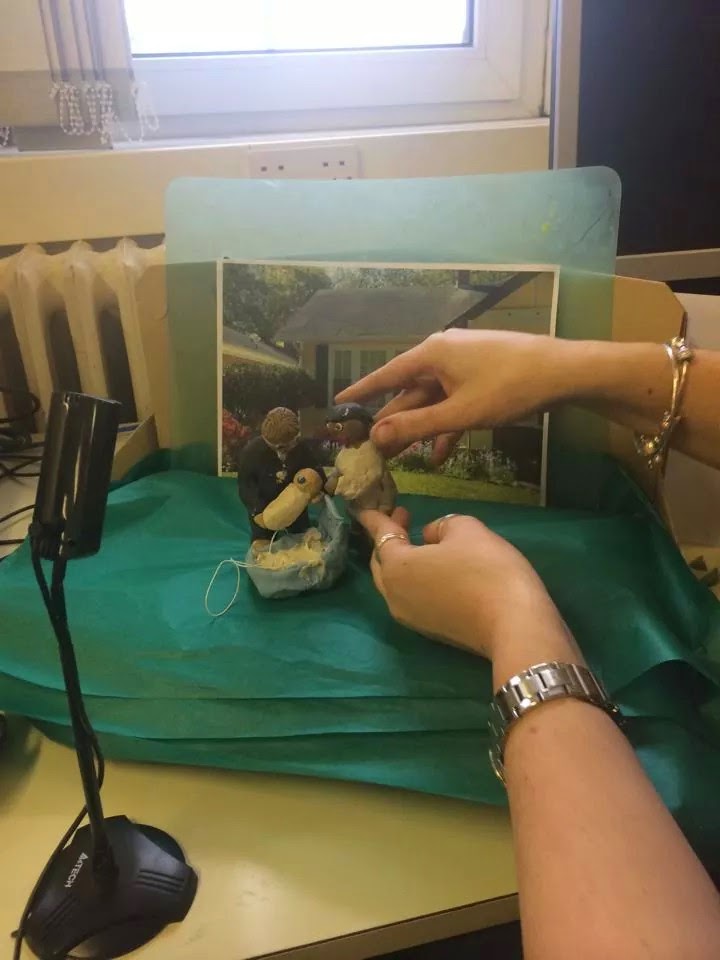
Using Zu3D, as a collaborative piece of work, our group constructed an animation called The Circle of Life,  that we showed to an audience for critical analysis.  Our story represents a baby growing into adulthood, meeting a girl, having a child then growing old and dying.  We imported music to represent the story and to add emotion to the viewing experience.  We incorporated humour, fun and sadness into our animation with specific movement, sound effects to create identification whilst using different backgrounds to set the scene.  The concept was to be kept simple yet effective as in Mayer's (2001) cognitive theory of multi-media learning so not to overload the working memory for a deeper understanding of our message; life goes on.
 
Me moving the characters frame by frame.

It took a whole day to create all of the characters, a day to film the animation and another day to create the sound.  In my opinion, the adding of the sound was the most difficult.  We used the song Take Me On My Way by Rusted Root, as a main sound as it tied in with the theme of our story.  We then incorporated sound effects over the music to represent movement and human sound for the characters. 
 
This was a fun but time consuming learning experience which required patience while using both fine motor skills and higher order thinking. It can be planned for in cross curricular lessons and is not only a hands on way of learning but is also stimulates cognitively. This video of Zu3D at BETT 2015 shows how children learn with animation in a deep and interesting way. 


Our stop-motion  creation came with some technical problems. We forgot to save our completed animation as a movie which resulted in the sound disappearing. We did however record the animation with a mobile phone so when we presented our stop-motion animation we ran the sound off the phone to the computer whist playing the animation.
 
I was very proud of what we achieved.  The story as a passage of time in a young boys life was felt, laughing at the humour and I was moved by the ending.  I believe as a group we worked very well together, and even in the face of disappointment on discovering the hard work we put into the sound exactly matching the movements was in vain, we found a way to solve our problem.  It was not perfect, however it worked and I was very happy with the result.

This is the video that we recorded using a mobile phone.


This made me reflect on how sound does in fact have an enormous impact on a visual experience.  Sound does offer the viewer an added dimension of drawing ones attention and empathising with characters and understanding the message.

This is the animation we achieved with just the music background but without sound effects, it does not have the same affect than with the audio affects attached.


Overall, this learning experience came with positives and negatives, however as a whole it did reap many rewards.  I have learnt patience, stamina, organisation skills, team work, communication skills and reflective practice, all of which will assist in my career journey both as a primary school teacher and for the learners that I will be learning with alongside.

Wednesday, 8 October 2014

What is a learning environment?

Any learning environment must be adaptable and considerate to each individual learner.  But how can it be perfectly described?  This can present itself as a physical area, an ethos or an infinite invisible space. A learning environment can be traditionally observed as a classroom.  This physical space is adult prepared to stimulate the learner being rich with resources to engage the learner towards a central focus.  However, on reflection, everywhere can be viewed as a learning environment.  People learn at work, at home, with their friends and family...the list is endless.  However, the 21st Century learner can now enjoy an infinite space as a learning environment.  Virtual Learning Spaces, (VLS) are increasingly being used in schools, colleges and in the home as a new and exciting learning environment. 


Children of today need to be engaged and see relevance to their own learning or it is argued that they will become detached from their learning. The Schools Effectiveness Framework (2008) saw the calling for children to become responsible for there own learning, to become engaged in their learning within formal and non-formal learning environments. This recognised the need to change how and where children learn. Then in 2011, the then Minister for Education and Skills in Wales, Leighton Andrews reviewed digital learning in Wales and saw the beginnings of HWB which addresses the learning of all Welsh learners ages 3 to 19 years.  It is now clear to see that within classrooms today there is an array of digital learning tools from laptops to I Pads. The use of such tools for learning can be for research purposes, exploring film and music, to literacy and numeracy games that spans across the curriculum. The new Welsh Minister for Education and Skills Huw Lewis has published a new document Qualified for Life where he emphasises the development of skills that are transferable into the workplace.  This importance for transferring skills into a rapidly changing technological age is also noted within the document Essential Skills Wales. 

Palmer (1998) cited in Infed talks about a learning environment being bound; open; hospitable; inviting the learners voice; honour the students silence and welcome the learners speech.  So, positive, engaging environments for learning are essential with regards to technology in the classroom and at home to allow the learner to embrace their learning, take ownership of their learning and transfer these skills around the curriculum and into adulthood.  To marry virtual learning spaces into the physical learning space allows the learner to embrace learning in the 21st Century to develop skills to embrace new technological breakthroughs well into adulthood, allowing the learner to contextualise their learning into their own experiences at home, outside, or at school.